10 Tips for Writing Excellence From Top Writing Bloggers

Do you want to drastically improve your writing? Are you looking for new ways to boost your writing career, retain more clients, stick to your writing schedule, or get more readers addicted to your blog’s content?

We asked the winners of our Top 10 Blogs for Writers Contest for their best advice on how to achieve excellence in the business and art of writing.

Here are their top tips. I think you’ll agree that there are some excellent ideas here.

#1: Dream Big, Write Big

Here’s what Larry Brooks of Storyfix, a blog on writing fiction, recommends:

“Not so long ago there was an elephant in the writing room: the work was all about getting published.

You did that by writing a great story.

But today, with digital venues having no qualitative criteria, the elephant has a new mantra: you’ll still need a reallygreat story. That is, if you want to sell to anyone besides your family and your critique group.

But not just any story.

Until recently, publishers did all the vetting. Today that power exists in the digital marketplace.

Which means you, the aspiring author, need to play the odds: a “small” story about your grandmother’s childhood in Des Moines is less likely to make a dent in the Amazon rankings than, say, a story that takes an astoundingly compelling concept and sends it sailing over the fence.

So think big. Out of the box. Don’t try to compete with James Patterson or Nora Roberts – you can’t, they’re still out there. Rather, become the next James Patterson or Nora Roberts by swinging for that fence.

Write the story you were born to write. Do it now… the door has never been open wider.”

Top Ten Blog For Writers Nomination: Jennifer Blanchard loves Storyfix because “Larry tells it like it is–there’s no sugar-coating whatsoever… Larry’s blog is invaluable for any writer who wants to be successful in the fiction writing industry.”

#2: Why Your Writing Doesn’t Really Matter

Here’s what James Chartrand of Men with Pens, a blog that offers “world-class web design and web copy,” recommends:

“Most writers jam up. In fact, very few writers actually write with complete peace of mind, firing off words and then hitting publish without a doubt in the world. They edit. And re-edit. And edit again. Stress levels go up. Self doubts rise. And hours of blood, sweat and tears go into the smallest pieces of writing.

Here’s the thing: Your writing doesn’t really matter.

That doesn’t mean you shouldn’t care about making your writing the best it can be. You should edit and try to catch the typos, use proper punctuation and grammar and work out the kinks in awkward sentences, sure.

But there comes a time when you need to stop twisting yourself up in knots. Let the writing go. Because it doesn’t really matter.

What I truly mean by that is that the medium of your message isn’t as important as you think it is. People don’t get excited over “perfect” writing. They don’t leave comments that say, “Wow, that was some damned fine editing!”

No. People get excited about the message you have to share. Not your “perfect” writing.

And if you’re preventing yourself from letting people see your writing because you’re stressing over the perfection of it… well, your message never makes it out there to the people you want it to reach.

So give yourself permission to write what you need to write in the way you want to write it. Stop stressing over what people will think of your work. That’s not important. Start getting excited about sharing your message instead – and making sure that the people who need to hear it actually do.

Your writing doesn’t really matter. Your message does.”

Top Ten Blogs for Writers Nomination: Andrea Vahl loves Men with Pens because "James consistently delivers thought-provoking posts on writing, web copy and small business."

#3: The #1 Reason Your Blog Post Goes Unread

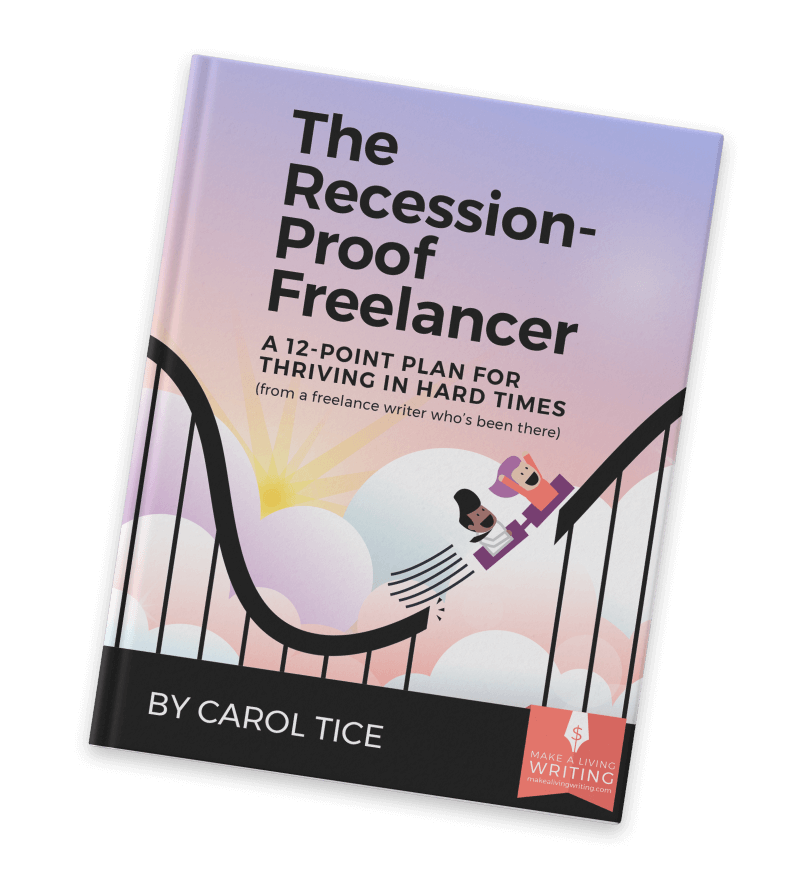
Carol Tice of Make a Living Writing, a blog that offers “practical advice for hungry writers,” says:

“Did that headline make you feel you simply had to read this section? You’ve just seen a demonstration of why strong headline writing skills are essential for writers who want to succeed in the Internet age. If you can write intriguing headlines with key words, it will help your audience find you. You can really stand out from the crowd, too — I reviewed more than 100 writer’s blogs recently, and weak headlines were the single biggest problem I saw.

Where newspaper headlines have a subhead to help fill in the details for readers, online your headline stands alone. It must grab readers who see it on search engines and compel them to click through to your piece, or you won’t be read. Strive to make your headlines both meaningful and intriguing. In my view, improving your headlines is the single most powerful thing you can do to help your online writing career.”

Top Ten Blog For Writers Nomination: Stefanie loves Make A Living writing because “Carol has a wealth of information for anyone looking to have a freelance writing career success story.”

#4: To Get Inspired, Embrace the Mundane

Judy Dunn, founder of Cat’s Eye Writer, a blog that helps bloggers “get their posts noticed more, read more and shared more,” recommends:

“Whether you are writing a blog post, telling a story in a marketing piece or penning a novel, ideas and topics are right in front of your face— if you watch and listen.

In everyday life—at the grocery store, at the bank—turn the camera on yourself. Carry a notebook and record what you see and hear. There is enough bizarre behavior out there to spark the creative juices indefinitely.

Mine your family for rich material. I spun my experiences in raising my daughter into stories that are still educating, engaging and entertaining my blog readers.

Writers should be avid readers. Reading across genres is a catalyst for new ideas. It improves your vocabulary. It helps you find your voice. It shows you how to touch the senses and emotions in writing. And it helps you tell your stories better. My reading ranges from children’s books, true crime and memoirs to 19th century classics.

Finally, write, write, write. I am a big fan of free, stream-of-consciousness writing because it brings me some of my most unique ideas. Try journaling for 15 minutes every day and see what happens.”

Top Ten Blog For Writers Nomination: Patty loves Cats Eye Writer because Judy’s “advice is practical, useful and presented in a style that is enjoyable to read.”

# 5: Blast Perfectionism and Thrive

Linda Formichelli, author of The Renegade Writer, a blog about “living and loving the freelance life,” recommends:

“I teach and mentor writers, and a huge sticking point I always hear from them is that they’re afraid to put their work out there if it’s not perfect. So they wait and wait, and get caught in analysis-paralysis — and of course, they have no success.

I don’t know about you, but nothing I do is perfect. That includes the way I parent my toddler, my cooking skills, and — you got it — my writing. And yet, I’ve been published in more than 130 magazines, from Woman’s Day to Health to Redbook.

Let me assure you: There is no such thing as perfect. Editors (and readers) are all individuals so what one loves, another will hate. You can’t predict it. All you can do is do your best and get your ideas and your queries and your letters of introduction out there. The mediocre idea you send out has an infinitely better chance of being accepted than the one that you never send to an editor because it’s not “perfect.”

If it makes you feel any better, when I was first starting out, I sent out some terrible ideas, including a query to Family Circle called “Quik Dri Cheez: Why Advertisers Can’t Spell.” No one blacklisted me for sending out imperfect ideas. I learned from my mistakes, kept pitching, and ended up writing a dozen articles for Family Circle after that. If I can do it, so can you.

Now: Get pitching!”

Top Ten Blog For Writers Nomination: Dana Britt loves The Renegade Writer because she has “learned SO much and gained so much insight on writing and a writer’s life from this blog.”

#6: Understand the Importance of Perseverance

Therese Walsh of Writer Unboxed, a blog about “the craft and business of fiction,” recommends:

“I’m not sure who said that the difference between an unpublished and published writer is perseverance, but I believe it. I worked on one fiction project from 2002-2008; my debut novel, The Last Will of Moira Leahy, was published in 2009. Why does it take such a long time to perfect a story? Because even though we begin the writers’ journey believing we know enough to write a book, we usually don’t. As we write–if we’re able to cast a clear eye on what we’ve written–we’ll see weaknesses in our prose, our characters, the structure of our stories. We’ll pick up craft books and ask critique partners for guidance, and apply new ideas and knowledge to our works-in-progress. Until we hit the next snag, and then again we’ll try to understand what the problem is, and we’ll learn more, then make new changes. This may seem a crazy process–write, learn, rewrite. But in the beginning, it may be the best way to produce quality work. You must have something inside of you that says write, learn, rewrite, don’t quit, repeat. Listening to that voice truly can be the difference between the unpublished and published writer. Write on!”

Top Ten Blog For Writers Nomination: Rachael Herron loves Writer Unboxed “for their sheer number of inspiring, helpful posts from a great variety of writers!”

#7. Establish a Consistent Writing Routine

K.M. Weiland of Wordplay, a blog that focuses on “helping writers become authors,” says:

“The only way to succeed at the writing business is to treat it like business. That means showing up for work every day, rain, shine, or smog. Write every single day, if possible. If not, plan a workable writing schedule that will allow you to write on a regular basis—and then stick with it. You may be able to set aside several hours a day, or you may only be able to manage twenty minutes. Start small if you have to, and work your way up. Bestsellers have been written a paragraph a day. It isn’t quantity that’s important, so much as consistency.

Once you’ve chosen a reasonable schedule for your writing, stick with it like a bulldog on a drumstick. Remember: The only person who can make your writing a priority is you. If you’re not willing to make sacrifices and enforce your writing time, no one else will do it for you. Explain the needs of your writing schedule to family and friends, asking them to respect your need for privacy during this time—and then guard your desk with a machete and a flamethrower if necessary.”

Top Ten Blog For Writers Nomination: Lindsey Lucas loves Wordplay because “her posts are always immensely helpful but still condensed enough to read even if I’m busy that day. …I feel as though she’s an old friend giving me advice over a cup of coffee.”

#8: Write What You Love to Read

Joanna Penn, author of The Creative Penn, a blog about “writing, publishing, and book marketing,” recommends:

“For years I was held back in my writing because I thought I had to write Booker prize-winning literary fiction in order to be a ‘proper’ writer. I also thought that every sentence had to be perfect when it went onto the page. These two misconceptions blocked me for a long time. But it’s not true! Take a look at your bookshelf and chunk it down into what you’re passionate about reading. I realized that I had mostly thrillers and books on religion and psychology – these are the things that consume me and drive my interest. So I started to write a thriller that blended these topics and it was so much fun to write! If you’re writing what you’re passionate about – whether it’s your blog, ezine article, fiction or non-fiction book, then you won’t find it hard to enthuse about your writing. It’s also important to know your market and if you’re writing what you love to read, then you will naturally hit the right chord. Let that passion carry you through a first draft and then edit your way to a brilliant finished product.”

Top Ten Blog For Writers Nomination: Monique Wildewood loves The Creative Penn because Joanna “helps budding authors from woe to go with plenty of good advice, links, and personal experience.”

#9: Love Blogging for Writers

Victoria Mixon of A. Victoria Mixon, Editor, a blog that focuses on “the art and craft of fiction,” recommends:

“Writing and blogging aren’t about what you get from others, they’re about what you get from yourself.

So love it. Love blogging for writers.

Love writing—the tools and techniques of written language, the humanity that comes through understanding readers, this art that gives words to everything in life that has no words.

Love writers— your audience and inspiration. It doesn’t matter whether you have one reader or thousands or if the only person reading is you. Whoever they are, that reader is a writer. Appreciate their presence in your life. Love them for loving what you love too.

Love your life—the source of all writing. You don’t have to blog about yourself. But if you pay attention to the world around you and write in telling, significant details, crafting each post along the classic structure of storytelling (hook, development, climax), taking your time to draft, revise, and polish your voice until each post is the best post it can possibly be, striving always to say something unique, something that truly needs to be said. . .

Then, no matter what your numbers are, you’ll get the most out of yourself. And that’s the excellence in blogging for writers.”

Top Ten Blogs For Writers Nomination: Roz Morris loves Victoria Mixon because she is “Hilariously funny, deeply wise. She’s an editor who really knows her stuff."

# 10. Learn How to Inspire Your Readers

Ollin Morales, author of Courage 2 Create, a blog that offers “writing and life advice,” recommends:

“For me, writing isn’t worth it unless it inspires.

People seem to believe that if you show your reader a character who is at her most successful and does not have one speck of ugliness, inconsistency, or imperfection in her, that this character is inspiring in herself.

That isn’t true.

Whether your character is a character in your novel, or whether your character is YOU as a character on your own blog, the key to infusing your reader with knock-off-your-socks inspiration is by doing the complete opposite of what you think will inspire:

Show your character as ugly, imperfect, needy, arrogant, confused, lost, struggling, in pain–show her at her absolute lowest. Be brutally honest.

Why? Because your readers will relate. Why? Because they’ve been there, too.

Once you got your readers relating, show how your character triumphed, even though all the odds were stacked up against her.

Have her say to your readers:

“Yeah, I know life’s tough. But you can make it through, in spite of it all.”

The deepest of valleys are what make the highest of mountains. So make the valley of your story 10,000 feet deep, so that its peak is twice as high.”

Top Ten Blogs for Writers Nomination: Linda loves Courage 2 Create because "Ollin has a wisdom beyond his years that allows him to write honestly and on a level so relatable it feels as if you’re reading advice from a good friend."

Now It’s Your Turn

These tips are the beginning of a great foundation to achieve excellence in the art and business of writing.

What do you think? How do you achieve writing excellence? What other tips do you have to share? Please leave them in the comment box below.

The (nearly) Ultimate Guide to Better Writing

Become a better writer overnight with this FREE eBook
  • Find daily inspiration
  • Improve your writing overnight
  • Get started, even when you don’t feel motivated
  • Complete what you start
  • Get WTD updates
Fill out the form below and get your copy immediately!


132 Responses to “10 Tips for Writing Excellence From Top Writing Bloggers”

Read below or add a comment...

  1. Antonio says:

    Great post.
    Many thanks for this contribution. It’s really all about these 10 tips.

    Thanks.
    Antonio

  2. Charles Tutt says:

    I’ve written several books. First one was 10 years ago. I’m still editing and re-writing them. Haven’t published the first one yet. This is one of the most useful and inspiring articles I’ve read lately. You’ve rekindled my fire.

    Thanks

  3. Raul Sim says:

    Excellent writing can be aquired if you publish only pieces you are really proud of, pieces you can call “perfect”, perfect as in good enough. I highly recommend writers to set high standards, because that’s how you get awesome work done, even if it takes longer time. Remember, quality is WAY more important than quantity.

    • For sure no one should set low standards, and we should all strive to do our best, but it’s important not to get stuck in that trap of writing “perfect”. There’s no such thing, really – and it could lead to a huge, big ol’ writer’s block in no time!

      • Raul Sim says:

        Well, define perfect. I understand (human) perfection as the peak of the mountain, the reached point where you’re proud of your work and think it’s a finished piece. In this sense, I’m a perfectionist.

        I understand what you mean, though. But editing and editing and editing a piece of writing will always get to a point where you love the result. If you improve a lot, it doesn’t mean your gonna go in a constant process that never ends. Our best means the point where we can’t improve any more. At this level, our work can be called “masterpiece”.

        • Raul, you’re on absolutely the right track. Editor and bestselling ghostwriter Roz Morris & I are discussing this exact topic today over on my blog, in Talking Prose—please feel free to join us!

    • Judy Dunn says:

      I wrote an entire blog post on perfect. I call it “The Princess Syndrome.”

      http://catseyewriter.com/2011/02/04/why-most-people-quit-blogging-the-princess-syndrome/

      High standards are great but, if you are like me, you’ll be sitting on your deathbed, saying, “Wait! Wait! NOW I know how to finish this story. I’ll just revise that manuscript again.”

      I would advise people to write from the heart, revise, edit and then send it out into the world. Because that will be the feedback you need to see if you are on target.

      Thanks for the tips you shared here, Raul.

      • Raul Sim says:

        If we don’t aim for our best, we get bad content. That’s why most of us fail. We not only should, but must be perfectionists. That’s my philosophy and the way I work.

  4. Barb says:

    Fantastic post! There’s so much inspiration in one place, I’m going to bookmark it!

  5. Andrea says:

    What an encouraging post. Thank you so much for sharing!

  6. Great post. I particularly connected with the advice to establish a writing routine, let go of perfection and also focus on the message and not the editing. I would add that you should allow your writing to evolve and change with time. I also write poetry and short stories and it took me forever to accept that it is okay to write about something either than being angry and a woman and once I allowed that to happen my writing took a whole new turn and is more honest because it reflects where I am in my life at this point, which always shocks me because I never know where I am until I read it in my work. Excellent post, thank you for sharing.

    • You know, that’s a good point – letting your writing style, mood, or tone change can be very liberating and educating. Learning to write in different ways and growing with your skills can lead you to new paths you never thought you’d trod.

      • Larry says:

        The trick is to harness that passion — including anger, if that’s what moves you to write — but within a professional context that applies an enlightened author’s filter and comes from the reader’s point of view, rather than yours. The combination is killer, when it works. Writers are notoriously passionate, so it’s not a bad thing when tempered by knowing what works on the page, versus what works with your therapist. May your words rage and shine, and may your readers learn from you.

    • Judy Dunn says:

      Vangile,

      So great to connect with you here! I love your comment about your writing evolving over time. With me, that has certainly been true.

      I find that I don’t write so much from being a woman as I do from being human.

      Thanks for sharing your perceptions here.

    • K.M. Weiland says:

      Thanks for reading! Yep, I definitely concur on *allowing* your style to evolve with time. It’s a matter of giving yourself permission to think outside the box, try crazy new ideas, and generally live (and write) on the edge. We have to risk big things to gain big things.

      • @Larry: Yes harnessing my anger has been a journey all of its own. I write a lot about my anger but I have learned that anger is the basis for destruction and creation. Anger at the way things are can force us to create things as they should be.
        @James: I have learned that letting ourselves evolve takes courage because it means letting go of old identities
        @KM: Thank you for reminding me that risking big things leads to big gains

  7. Fantastic advice. Thanks for this post!

  8. One of my favorite pieces of my published writing was a letter to the editor of The Christian Century. The cover article had been written by a minister from the Kansas City area where I also live and I knew it deserved a response. I felt compelled to write it, but I also knew time was of the essence. I read the the essay several times. The subject was global voyeurs, those Americans who channel surf their way past the world’s problems with nary a glance.

    I went to the downtown branch of the Kansas City Public Library, found an appropriate quote from The Courage to Love by William Sloane Coffin, wrote a letter using a quote from the Coffin book to compare with a point the article writer made and suggesting that we begin to see ourselves not as voyeurs but as global voyagers with our fellow planet dwellers, and fired it off to the magazine back in the days when we still used snail mail. Two weeks later, when I turned to the Table of Contents of the November 11, 1992 issue and saw “Global Voyagers” after Letters I knew I my hook had caught an editor’s eye.

    • Judy Dunn says:

      Barbara,

      Not surprised to find you here. You appear to be a life-long learner. : )

      Good for you…acting on something and catching that editor’s eye. Good for you!

  9. Thanks for your nice comments, everyone! I’m honored to have contributed to the post along with the other top-tenners.

  10. AD Bane says:

    Fantastic Post. Thanks a lot!

    From my own experience, writing happens best when inspiration and motivation are both taken in equal, controlled measure; that is where true genius comes from!

    • K.M. Weiland says:

      I agree – although I would add that, in my experience, motivation is often what *allows* the inspiration a healthy and inviting atmosphere in which to grow.

      • Just a quick note that it’s a good idea to avoid giving adjectives power to control our lives. I’d say more that it’s YOU allowing inspiration a healthy and inviting atmosphere versus “motivation” – it’s not a thing that has that kind of power, make sense? But you do… :)

        • AD Bane says:

          @KM, that is quite true; inspiration seems to be rather reclusive if you do not already have enough motivation.

          @James, I would definitely agree! Regardless of what you MAY have access too, it is YOU that can harness and control the flood when it comes. However, I think it is also true that that same inspiration can be equally as destructive if you do not control it…

    • Judy Dunn says:

      AD,

      Wow. What a profound statement. Those two things coming together is the best of both worlds. Thanks for sharing that. : )

  11. Celia Stander says:

    Thanks for a great post, very inspiring. I think I am currently suffering from analysis-paralysis! :)

    • Judy Dunn says:

      Celia,

      That is my worst affliction. Analysis Paralysis? I understand it well. I tend to be a reader and studier. : )

      • Just Clock in and Clock out Celia. Say you put in 5 hours today, and don’t demand that it be your best. Before you know it the excellence will come of itself. Good luck!

    • Celia, I adore this term “analysis paralysis!” I may have to snag it for a blog post sometime soon–with a hat tip to you, of course. (Psst, I’ve suffered from AP myself, and I’ve found that the best cure is a madcap writing session or seven. Put yourself in NaNoWriMo-mode regardless of the month. As you’re rushing to achieve a crazy word count, analysis paralysis fades and you’ll feel your creative drive at the helm again. At least that’s what works for me. Good luck!)

  12. All good points but I’m a little wary of #2. Your writing does matter and if you self publish before it’s good enough, you’ll crush your career before you begin. Get an editor before you do it and you’ll at least save yourself the embarrassment of looking unprofessional.
    http://tahlianewland.com/2011/04/02/indie-authors-please-pause-before-you-publish-for-all-our-sakes/

    • Heh, I thought that editing at least once went without say – my tip was for those stuck in editing and not moving past it! :)

    • This is a really good point, Tahlia. Once upon a time, you could count on your publisher giving you an editor to help you realize your inherent potential, but these days the responsibility for that lies squarely on your own shoulders. I work with so many aspiring writers who would love to be publishing right here, right now, but don’t realize being a writer is a lifelong career choice, not a quick trip to the corner Fame Grocery Store.

      I’ve been learning to write for thirty years, and I’m still on the path. You do this work for as long as you need to and luxuriate in the process because it’s what you love to do. That’s all.

      • In my opinion I think its about the hierarchy of wants, not a hierarchy of qualities.

        1. You want to have a great message for your reader.
        2. You want to be able to express that to your reader with great writing.

        That is not to say that your writing should be less quality than your message, it means to say that you want to start off with getting your message straight before you think about the writing itself.

        I think what James means to say, and what I see as well, is that people get caught up in the writing itself more than just the message.

        You can have great writing but your message may be weak, or it might be all over the place.

        I think James is just making sure people don’t forget what drew them to writing in the first place. Whether it is fiction or non-fiction, you want to get your point across.

  13. Marya Writes says:

    This is a fabulous post, I thoroughly enjoyed reading it. My favourite ones are, write to inspire your readers, writing is not about perfection, but about the message (Men with pens) and how your headline is crucial for your post being read. (Carol Tice).
    This is by far my most fav place for tips on writing. Thanks guys.

  14. Wow what a great resource! I just discovered a couple new favorite blogs! This will definitely be bookmarked…Ollin, I love your blog, fantastic stuff. And Larry, you’re post referencing “The Fighter” a while back was one of the best things I’ve ever read.

    Thanks for the inspiration…I’ll be sure to check out all ten blogs.

    • Thank you Joe! Yeah, definitely check out each of these blogs. I’ve come to know these bloggers very well over the months, and if you love me and Larry, you are gonna love the rest of the bloggers featured here. I guarantee it!

    • K.M. Weiland says:

      Larry’s post on “The Fighter” was one for the ages, but definitely. Thanks for reading, Joe. Glad you got something out of it!

  15. It’s tough that both my brothers are tenured English Professors at major universities – as a business owner I used to worry a LOT about what I wrote. Finally I just started writing about my experiences – funny things that happened while being a sales trainer and business coach – like the woman hired to do sales who despised using the telephone. I started collecting stories.

    Judy, i have my handy notebook with me at all times. Bad customer service experiences turn into some great fodder for blog posts – no experience is a negative one anymore – and I am working this year to take my writing up a notch – where a well-thought out post is shared and re-tweeted, because it adds value. Thanks to all of you “real writers” who offer such great ideas and tips.

    • You’re welcome Lori!

    • K.M. Weiland says:

      I have this pet peeve about the designation “real” writer. If you write, you’re a writer. Period. Don’t sell yourself short by not claiming that title and shouting it to the world. Published writer? Bestselling author? Maybe not. But you’re a writer nonetheless!

    • Judy Dunn says:

      Lori,

      Good to see you here. I would venture to say that sometimes (not all the time), having a degree in English does not make you a better writer. I have had clients run their my marketing copy by the “sister-in-law who majored in English” and it comes out bland and voiceless.

      I’m glad you carry that notebook because life experiences will give you some of your best blog posts. And I agree with K.M. If we write, we are writers. All of us. : )

  16. What a grand post. I learned so very much, thanks to all of you. Judy, a BIG thanks for mentioning this article on your blog. You are the best. xxpeggybraswelldesign.com

  17. Matthew Cook says:

    Wonderful, encouraging stuff!

  18. Mary Jaksch says:

    Thanks for putting this fantastic joint guest post together. It shows why you were all winners of the Top10 Blogs for Writers competition!
    - Mary Jaksch

  19. Lisa Rivero says:

    This is a keeper! Thanks so much for not only putting together the advice but including the aesthetically pleasing graphics. :) I don’t think I’ll ever get old enough to take for granted the information that is not available at the click of a mouse.

  20. doug_eike says:

    If you are inspired, your readers will be, too. True inspiration shows through clearly, even if you haven’t the ability to edit your work as well as you would like. The writing process is twofold, and those who understand that write far better than those who do not. The first part is the inspiration, the flowing prose that comes from forgetting who you are and just writing. The second part is the editing, the refining of the piece into the most efficient set of words possible, without, of course, destroying the spontaneity of the original piece. Thanks for the article!

    • My rule if you don’t LOVE your post, or your book, or your article, chances are you readers won’t love it either. The best thing to do is set out to write a post you will love and hope your readers will LOVE as well. And then let it go. Some might no understand it, some might think its okay, some might even hate it, but the only thing you can control is whether it inspires you and inspires you.

      You are absolutely right that inspiration starts with the author. Thanks for sharing your thoughts!

      • Heh, actually, my experience has been different: you can never assume your audience’s reaction. Posts I think won’t do much go viral, posts I think are glorious fall flat.

        But I’ll agree on one thing: If I hit the publish button, then that’s my personal “good enough for me”!

        • K.M. Weiland says:

          That’s been my experience as well. Almost every time I write a post about which I’m uncertain of audience reaction, hits and comments skyrocket. Never can tell what will happen when you hit Publish! As long as we insist on quality in every post, we have a right to personal satisfaction.

  21. I love having all of you experienced writers in one place offering your best advice! I do my best to keep a schedule for writing everyday, but I am also finding so many places to learn more about writing. I spend my days reading blogs for tips on topics that may have me stuck in place. My evenings are for writing and reading books. I love the learning, the research and mostly the writing. I tend to edit as I go along. It takes a little longer to move forward in the story that way, but I can’t leave a scene in a state that I’m unhappy about. My biggest fear is finishing the story and finding it isn’t compelling enough for readers. I don’t want a ‘nice little story’ that my friends and family like…I want something that will interest the masses to read book after book. Give up? Never! Take years to finish a story and get published? No way! I have a goal for completion, just as I have a daily goal for word count. I don’t worry about attaining perfection, but I do strive for it, being the best I can be. Thanks so much for all your posts. I subscribe to most of your blogs already and now will have new ones to read!

  22. Wonderful advice (great job on #10 Terese!)

  23. Inspiring post :) I think that an important aspect is “target” audience. When writing a post or story, one should think to whom it is targeted and write accordingly. That is a great part in a successful result.

    Thank you for an interesting article :)

  24. Marvin says:

    Excellent post with great tips. I especially like James Chartrand’s advice about the message you are trying to convey to our readers. I also like Ollin’s tip on humanizing your characters.

    • Thanks Marvin. It’s no joke: that is the best writing advice I can give. It is the secret behind my success, so I hope you all take it to heart and find it useful for your writing as well!

  25. Thank you for the encouragement! I love that the advice centers on working steadily, embracing imperfection, and accepting your messy first draft–all goals that the average person can easily attain.

    I would add that pushing the “I shoulds” from your mind so you can work on what you enjoy, instead of worrying about ever-present chores and bills helps a lot. I found that once I did that and gave myself permission to write (in whatever form), I felt more myself, less stressed out, and more productive (even if what I wrote is not published anywhere yet!).

    • K.M. Weiland says:

      Excellent point. If we don’t give ourselves permission to write, no one else will. I believe in *making* time much than finding time. For every thing we decide to include in our lives, something else has to go. Sometimes, the sacrifice is something relatively small and pointless (like that extra hour of CSI), but sometimes, it’s something big and scary. We have to consciously decide if our writing is worth the sacrifice – and, if it is, we have to surrender all the guilt and embrace the cons of the writing life along with the pros..

  26. Prime says:

    Thank you so much for these 10 helpful, useful, effective and inspiring tips! Thanks to oDesk of course and you brilliant writers behind this. At age 15 I love to write, but since my program in college dealt mostly on numbers, it gradually took me away from writing. Now, you lit the fire in me once again and I have learned a lot from this. It’s not my sentences or paragraph that really matters, but the message of it! Wow!! Now, I think I have to unleash my mind again, I do not have to be afraid after reading this! Thank you. You got 2 thumbs up from me!

    • K.M. Weiland says:

      You go! So many people get caught up in the idea that writing is about properly structuring words on paper (and, of course, it is, to some extent), but, as James said so well, the finer techniques are only a tiny part of writing. Few of us began writing because we loved diagramming sentences; most of us write because we have something say – and we learn the “rules” along the way.

  27. Barbara says:

    Doesn’t it all come down to BIC–Butt in Chair–and writing what’s in our hearts as clearly as we can depict the emotions, the themes, the characters? Some days I have to get it “right.” Other days, I can write shi**y stuff knowing I’ll go back and make it better. But if I don’t show up every day, grateful I get to write, why would I expect what I say to resonate with any readers?

    • Judy Dunn says:

      Barbara,

      Yes. Sometimes that self-disicpline—BIC as you call it—is underrated. The ideas part is easy (at least for me). The putting the time in, writing through days you feel blocked, etc., that can be more challenging. If you have learned that, you are well on your way. : )

      • K.M. Weiland says:

        BIC represents all the best traits: tenacity, self-discipline, grit, willpower. Without them, we’re stuck, no matter how talented or inspired we may be.

  28. I wish I could focus in on a more specific genre/niche with my blogging, but I have such a wide array of interests, it seems like too much to ask to narrow it down. I think I’ve at least got some of these tips down though!

  29. My tip: Turn yourself inside out.
    It is easy to walk into a crowd and project an image of control and professionalism. But this doesn’t work in medicine nor, do I believe, in writing.

    Try this, turn yourself inside out…let the raw nerves and fragile feelings, the giddy optimism, the child’s wonderment show on the outside. Pull the protective shell, the belief in yourself down into your core and let it be the skeleton of your personality.

    The inside-out man is approachable, loveable, vulnerable…a creature with an endoskeleton. The outside-in man has an exoskeleton and is, well….an insect. Most human beings seek the humanity in others…there is no reason to believe that readers feel any differently. Turn yourself, AND your writing inside out.

    S

    • Judy Dunn says:

      Steven,

      You bring up a good point. “The child’s wonderment” is exactly what you need as a writer. It is looking at things with fresh eyes, as a child does.

      I wrote something on this for Ollin’s blog: “5 Reasons First Graders Would Rule Your Writing Blog.” It’s about writing blog posts, but it aligns very well with your comment:

      http://ollinmorales.wordpress.com/2011/03/09/5-reasons-first-graders-would-rule-your-writing-blog/

      • Wow, beautifully said Steven. I often turn myself inside out on my blog, my readers seem to enjoy this approach. Great addition to this list of tips! Oh and definitely check out Judy’s post, it is excellent! And while you’re there you might see some of my other posts. I tend to go into the deeper side of the writing process, so you might enjoy it and appreciate it.

  30. Out of all 10 of these excellent, encouraging points, the one that resonates with me most right now is Ollin’s on inspiring readers. So often, we writers think only of the story we want to tell and how we want to tell it. When we turn our attention inward in that way, we forget that we’re not writing the story for us.

    We’re writing it for our readers.

    What do they want? What do they need? Will they react favorably to a story that is mostly authorial navel-gazing? No way! They’ll turn up their noses at a writer’s self-indulgence — and rightfully so.

    Of course, we should tell the stories we’re inspired to tell. But we must learn to tell them in a way that connects and communicates with readers. Whistling in the dark doth not a writing career make. ; )

    • Brilliant Courtney. I’m glad my point resonated with you so much.

      I find that it is hard for bloggers or writers to go to those vulnerable parts of ourselves. We don’t want people to see us looking ugly, but between you and me Courtney–showing my ugly side as well as my good side has shot up my readership. It’s incredible what honesty can do. Suddenly my readers don’t have to feel so bad if they feel like nothing is working for them.

      The most important point is to make sure that low point is met with a high point. Don’t ever let your reader hanging in despair or negativity. That is one of the biggest mistakes bloggers make. I’m not suggesting you do that. I suggest you show them the low part, but make sure there’s a high part.

      That way, your blog has a powerful influence on the world, and before long, you’ll be changing people’s lives and your blog will be more than just a blog–it’ll be a force of light against the darkness in the world.

      much love to you!

  31. AWESOME article with tons of resources. Thank you so very much, a wonderful treasure!

  32. Single Dad says:

    I think I found your site from one of the sites on this list (Renegade I think?). I’ve been writing for years, but mostly for myself or for relatively dry subjects like technical manuals. I’m glad I don’t have to reinvent the wheel when it comes to my (hopeful) transition to more creative writing. Thanks for posting and I’m looking forward to reading more!

  33. Wendy B says:

    I love all of these comments, as an aspiring writer with a fear of letting anyone see my work…I’ll bookmark all of these, and I think I’ll enter into a contest

  34. amber says:

    I am going to bookmark this and read it whenever I need a pep talk or hit a wall. Thank you!

  35. All good stuff … but it seems the real hurdle for writers these days is getting their work noticed in the marketplace. I don’t know how good of a writer I am, but I know I stink at marketing … partly from ignorance, but mostly from lack of willpower.

    • You should definitely check out Joanna Penn at thecreativepenn.com. She has a lot of great advice on marketing. I’m not there myself, but I’m certainly going to check out her advice once I get to that point.

  36. montana gray says:

    Excellent information! Thank you so much. Because of your
    tips I WILL “focus and finish” _ and leave the perfection
    for the next person.

  37. Heddy Keith says:

    This is an awesome article. The tips given are so true and helpful. Thanks much for the tips.

  38. #3 struck a lightning blow, specifically: write intriguing headlines with key words. Yes! I need to do that.

  39. Great review! You actually covered some valuable news on your blog. I came across it by using Google and I’ve got to admit that I already subscribed to the RSS feed, it’s very great :)

  40. A couple of years back I read ‘”A good plan executed immediately is much better than a perfect plan executed a week later”. Ever since then I have been trying to push myself to doing things immediately, without delay. Great article, thanks!

  41. Wow !!! Really Great Post,Good tips about writing.

    Thanks
    Abhinav
    SAP Help Online |SAP MM Tutorial | Free SAP MM Purchasing Tutorial